


.svg)
I-Shaped vs. T-Shaped vs. M-Shaped: How Do Innovators Think?
What separates innovators from other people? What is it that allows them to think outside the box and come up with new, innovative solutions?
It’s one of the great mysteries of innovation, and there’s not just one black-and-white answer. However, it’s safe to say that innovators think differently. If they didn’t, they wouldn’t be able to innovate.
To understand how someone thinks, you need to understand how they approach knowledge. So let’s look at three different knowledge profiles (I-shaped vs. T-shaped vs. M-shaped) and how they impact innovation. Then we can explore how to develop a knowledge profile primed for innovation.
I-Shaped vs. T-Shaped vs. M-Shaped
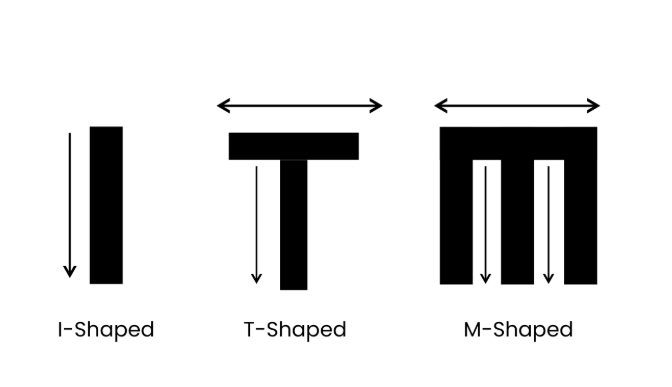
In rough terms, knowledge can be broken down into two categories: specialized and generalized. Specialized knowledge goes deep, while generalized knowledge goes wide. Using this, we can visually represent different knowledge profiles using the letters I, T, and M.
I-Shaped: The Specialist
The “I” represents deep expertise in a single field (a vertical bar). These individuals are specialists, spending their careers drilling down into one specific domain. They possess unparalleled technical depth, which makes them experts in their field but can limit the scope of their creativity.
For this reason, I-shaped people typically are not the ones who drive innovation. However, if you ever run into problems while innovating, they can be invaluable, as they often possess the tacit knowledge needed to work through complex, specialized problems.
T-Shaped: The Generalized Specialist/Specialized Generalist
The “T” represents deep expertise in one area (the vertical bar) coupled with a broad understanding of related domains (the horizontal bar). With both breadth and depth of knowledge, T-shaped individuals tend to be good at bridging gaps. They’re able to collaborate across functions and disciplines and can often translate their specialized skills to broader contexts.
With both specialized and generalized knowledge, T-shaped people can often connect disparate ideas and see solutions others wouldn’t. They can grow to become excellent innovators.
M-Shaped: The Jack of All Trades
The “M” represents deep expertise in two or more distinct domains (the multiple vertical bars) along with a broad foundational knowledge across many others (the horizontal bar). M-shaped people are the multi-specialists, or modern dilettantes. They have achieved proficiency in multiple, often disparate, fields. M-shaped people are an evolution of T-shaped people. They have not only the potential to translate their skills but a proven track record of doing so.
An M-shaped knowledge profile is the most conducive to innovation. As the saying goes, “A jack of all trades is a master of none, but oftentimes better than a master of one.” An M-shaped person has built knowledge in a way that naturally supports the creativity of thought needed for innovation.
The Strengths of the M-Shaped Individual
In an era defined by rapid technological change, disruption, and the convergence of industries, the M-shaped person is uniquely positioned to drive innovation. Their strengths center on two crucial capabilities: synthesis and adaptability.
The Bridge of Synthesis
True breakthrough innovation rarely happens within the silos of a single discipline. It occurs at the intersection of previously unconnected ideas. M-shaped people are the natural architects of this cross-pollination.
Because M-shaped people possess deep fluency in two or more disparate fields (e.g., software engineering and classical music theory, or psychology and architecture), they can recognize patterns and connections that remain invisible to single-domain experts. Their ability to synthesize and integrate knowledge allows them to understand the bigger picture and bridge silos to develop novel, holistic solutions.
Their power is not just in knowing a lot, but in connecting what they know. This is the core of innovation.
Adaptation to Constant Change
The world today operates on short cycles. Technologies, market demands, and even entire industries can shift dramatically in a few short years. For the I-shaped specialist, such radical change can render their single, deep skill obsolete or irrelevant, requiring a difficult pivot.
M-shaped individuals, by definition, have already mastered the process of shifting focus, learning new domains, and achieving proficiency again and again. Their diverse skill set serves as a resilience buffer. More importantly, they have mastered the meta-skill of learning itself. This inherent adaptability allows them to pivot quickly, which is essential in innovation, as nothing ever goes perfectly to plan.
How to Become an M-Shaped Innovator: Serial Mastery
The path to becoming an M-Shaped individual is not about collecting shallow hobbies; it's about engaging in serial mastery. This involves a deliberate commitment to achieving deep, functional competence in a new field once mastery has been established in the current one.
- Define and achieve first mastery: Start by following the I-shaped path: achieve genuine expertise in your primary domain. This provides the professional foundation, confidence, and discipline required for future pursuits.
- Strategically pivot: Once proficiency is achieved, identify a new domain that is either completely unrelated (for maximum synthesis potential) or highly complementary to your first. This is where the M-person departs from the T-person. The T-person stays adjacent; the M-person sometimes leaps to an entirely different mountain.
- Engage in deep learning: Commit to achieving a second level of deep competence. This requires humbling yourself to be a beginner again, applying the meta-skills of learning from your first experience. This mastery doesn't necessarily mean becoming world-class, but achieving a level where you can contribute meaningfully, solve complex problems, and speak the domain's unique language.
- Repeat and integrate: Repeat the process. Each new mastery deepens the horizontal bar of broad knowledge and adds another vertical pillar of expertise.
There’s an important caveat here: an M-shaped knowledge profile does not automatically make you an innovator. Being M-shaped gives you the necessary knowledge and skills, but it is up to you to use them. You must actively look for ways to apply concepts from your older domains to the new one, and vice versa. This intentional integration is what creates the synthesis advantage.
The Future of Innovation Is M-Shaped
As we race headlong into the era of AI, M-shaped knowledge profiles will become more important. Machine learning excels at deep, narrow problem-solving—the very domain of the I-shaped person. What AI lacks is the ability to connect seemingly unrelated concepts and apply meta-learning across radically different fields—the strengths of the M-shaped person.
So a jack of all trades is a master after all, of innovation.
Related Posts
Innovation as Meditation: What a 150-Year-Old Workshop Can Teach Us About Breakthrough Thinking
We recently came across a piece in Big Think that stopped us in our tracks. Writer Eric Markowitz visited Kaikado, a tea caddy workshop in Kyoto that has been in operation since 1875...
